
AI Today: Beyond the Hype, Real Transformation for Your Business 🧠 🖼️
🕒 State of AI Today with ✍ Note-Taking (30 minutes)
🕒 State of AI Today Presentation with ✍ Note-Taking (10 minutes)

AI proficiency is NOT at your fingertips. The most critical challenge with AI is integrating it into your company-wide operations and getting all your people behind it. Accenture has moved its services strategy not only to continuous improvement (which we all should be concentrating on), but further, they have refocused their entire approach on AI-led reinvention. When a global consulting leader reinvents its strategy and focuses on reskilling its workforce for AI mastery, isn’t it essential to be inspired by this transformation?
In addition, whatever Large Language Model (LLM)you choose, the fundamental question is: Who owns the AI strategy? If an AI project falters — producing a damaging customer experience, exposing sensitive data, making biased or discriminatory decisions, or causing a costly operational outage — who is accountable?
Too often, the leader nominally responsible for AI shifts blame downward or sideways to protect their comfort zone. What happens when no one formally owns the risk, and no one is willing to accept responsibility for failures? Accountability, engagement, and follow-through evaporate.
Responsibility must be unambiguous, governance and project pillars clearly visible, and oversight active and committed. Every business leader should recognize that without named ownership and sustained follow‑through, AI initiatives risk becoming fashionable buzzwords — and expose the organization to significant, unmanaged threats.
AI Transformation

Before Developing Generative AI (GenAI) or Agentic AI,
Three Musts: Training. Training. Training.
Training, management team support, well-structured data, and updated processes are foundational elements for converting substantial AI investment into measurable returns.
A 2025 McKinsey survey indicates that roughly 10% of U.S. firms using generative AI report measurable value, with early adopters in marketing, sales, and product development seeing the strongest ROI.
Other 2025 analyses from BCG, Deloitte and Accenture confirm this upward trend, attributing gains to better integration, clearer use cases, and improved tooling since 2023.
The caveat remains: widespread, high-impact adoption still requires training, strategic alignment and process redesign, not just technology deployment.
Turn AI Complexity into Competitive Advantage:
Start up, Deploy Faster, Smarter, and with Less Risk
AI is not just another tool—it’s a new industrial revolution that translates into strategic imperatives. Being a business leader means that you should know, examine, and confidently apply AI as your industry undergoes an irreversible change. You gain knowledge, tools, and strategies to future-proof your business, encourage collaborative leadership, and create an organizational impact.
Many organizations waste extensive resources on isolated AI initiatives that fail to connect effectively with business objectives. You have to bridge that gap. Leaders who wish to remain competitive and achieve sustainable growth must pay attention to rapid developments in AI. It is changing sectors, reshaping employment, and reallocating resources, creating vast openings and vital hurdles. Companies such as Amazon (with warehousing automation) and Unilever (AI for HR recruitment) are using AI at scale to enhance efficiency by 20-40%.
Before adopting agents or chatbots, if you are not fully operational, focus on organizing your internal data first. Data is typically spread out across individual desktops, stuck in disparate systems, or ill-structured, thus hampering AI. Starting small with good data paves the way for success. Companies that have invested in knowledge management are more prepared to initiate successful AI pilots because they possess well-structured and accessible data that drive impactful outcomes.
We will have many illustrations of things to get done to implement AI with a minimum risk. Do not focus on daily news about AI. It’s overwhelming. But stay informed on the essentials, such as once a week. Concentrate on your use cases. That’s what counts.
1. Overcome the Boredom Of Repetitive Tasks: The Amazing Potential of AI
Generative AI’s Unique Impact
Unlike classical AI, generative models generate new content (e.g., marketing copy, product designs). Claude, Gemini, and other LLM (Large Language Models) tools reduce content generation costs by 80%. In contrast, Midjourney and other tools disrupt visual conception throughout the creative structure by allowing for image creation in seconds.
Integrating Chatbots in your website for customer support, provided it’s well-prepared and tested, is an excellent tool for improving resolution rates. There are many tools available, such as Zendesk and Intercom, as well as new ones to watch. See more on 6.
Industry-Specific Opportunities
✨ Healthcare: AI diagnostics (e.g., PathAI) improve accuracy in disease detection.
✨ Retail: Dynamic pricing algorithms (e.g., Uber’s surge pricing) optimize revenue in real-time.
✨ Healthcare: AI diagnostics (e.g., PathAI) | Disease detection accuracy.
✨ Retail: Real-time revenue optimization through dynamic pricing algorithms (e.g., Uber’s surge pricing)
✨ Manufacturing: Predictive maintenance (e.g., Siemens’ AI factories) cuts downtime by 30%.
Infrastructure Readiness
AI success depends on your high-quality, organized data. Audit data pipelines and invest in governance. Example: Walmart’s data lakes enable real-time inventory predictions.
2. Staying Informed: A Prerequisite for Leadership
Avoid “AI FOMO” (Fear Of Missing Out)
Resist premature adoption. IBM’s Watson Health scaled AI oncology tools too quickly, leading to a $1B write-off. Zillow’s AI-powered home valuation errors caused $500M in losses.
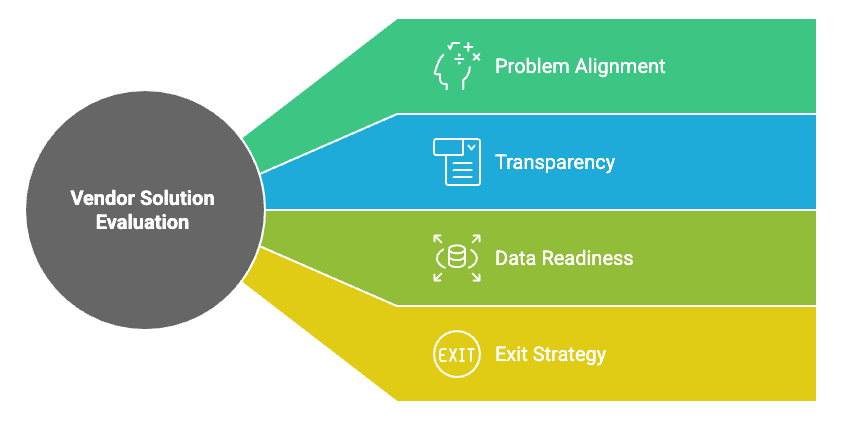
Framework: Test Before You Invest
For any new AI model/agent, ask:
1. Problem Alignment: Does this solve a specific business pain point?
2. Transparency: Can the vendor clearly explain and demonstrate how the model works?
3. Data Readiness: Do we have clean, labeled data to train/fine-tune this tool?
4. Exit Strategy: What does switching vendors cost if it underperforms?
Prepare to add as many open questions as possible (Why? Who? How? etc.)
Continuous Learning
(more in PILLAR 8: Your Training Organization, which you’ll encounter as you progress through the course):
✨ Dedicate weekly “The AI Intelligence Hour” to brief team members.
✨ Use resources like MIT Technology Review, or Partnership on AI.
3. Strategic Implementation: A Phased Approach
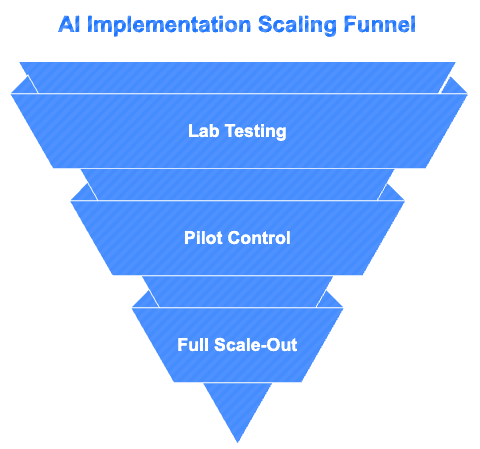
Tiered Scaling Framework
✨ Lab Testing: Internal sandbox environments (e.g., JPMorgan’s AI Lab tests NLP tools for contract analysis).
✨ Pilot Control: Limited user groups with predefined metrics (e.g., Starbucks tested AI barista voice assistants in 20 stores).
✨ Full Scale-Out: Proceed only after achieving ≥90% accuracy and employee buy-in.
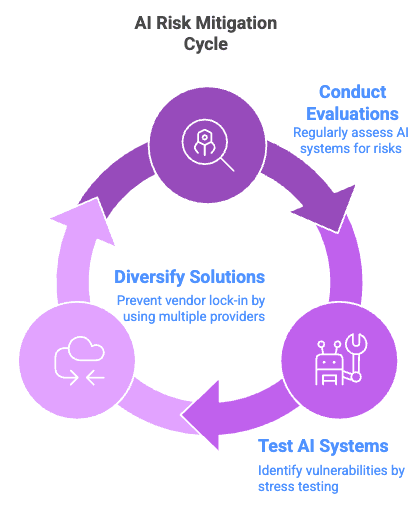
Risk Mitigation
✨ Conduct evaluations by an AI cross-functional team (more in PILLAR 7: Winning Teams, which you’ll encounter as you progress through the course)
✨ Intentionally break AI systems during testing. Example: Microsoft’s adversarial testing delayed ChatGPT’s release to fix vulnerabilities.
✨ Avoid vendor lock-in: Diversify between cloud providers (AWS, Azure) and open-source solutions
4. Addressing Workforce and Societal Disruption
Skills Before Tools
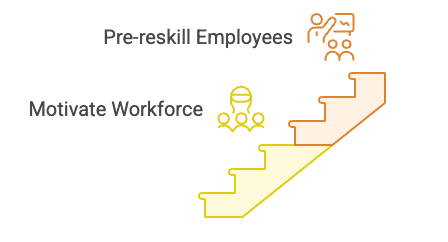
✨ Motivate workforce readiness with AI introduction videos and AI agent examples like this one, or this one.
✨ Pre-reskill employees: Airbus trained 10,000 engineers in AI basics before deploying design automation.
Policy and Compensation Innovation
✨ Advocate for portable benefits (e.g., Denmark’s flexicurity system) for gig workers.
✨ Allocate AI-driven savings to profit-sharing or equity stakes for employees.

5. Embracing Innovation with Vigilance
Collaborate cautiously and be creative in contracting
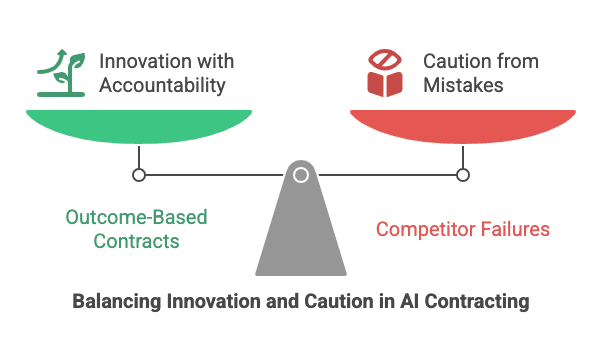
✨ Partner with startups via outcome-based contracts (e.g., pay only if AI meets accuracy thresholds).
✨ Learn from competitors’ failures: Meta’s overpromised AI ad tools eroded advertiser trust.
Case Studies for Inspiration
✨ Stitch Fix: AI stylists + human curators boosted customer satisfaction by 30%.
✨ John Deere: AI-guided tractors increased crop yields by 10%.
6. Real-Life AI Tools: Chatbots vs AI Agents
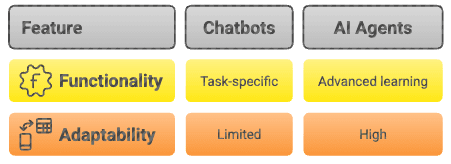
Chatbots and AI agents differ in their functionality and adaptability. Chatbots are task-specific, handling repetitive queries or basic interactions, while AI agents are more advanced, capable of learning and adapting to complex tasks. The time for action is now! Start small, learn, share, and test!
Immediate actions suggested:
⚙️ 1. Ensure your data is ready and organized before using simple chatbots to solve essential problems like improving customer service, enhancing user experience, or streamlining operations.
⚙️ 2. Assemble a small AI Task Force to audit capabilities, risks, and ethical guidelines and create an action plan with priority settings, responsibilities, and deadlines. Key drivers: facts and figures and deep research.
⚙️ 3. Allocate 5-10% of your R&D Budget (or create one) to AI experimentation.
⚙️ 4. To ensure responsible deployment, publish a 1-page AI Ethics Charter by year-end.
Real-Life Examples:
✨ US Company – Small Business (Chatbot):
The Farmer’s Dog, a pet food startup, implemented a chatbot to manage customer inquiries about orders and pet nutrition. Within six months, they reduced response times by 50% and saw a 20% increase in customer retention due to faster support.
✨ Asian Company – Medium-Sized (AI Agent):
Zenyum, a Singapore-based dental aligner company, adopted an AI agent to personalize customer consultations through WhatsApp. This led to a 35% increase in lead conversions and a 25% reduction in manual follow-ups.
✨ European Company – Medium-Sized (Chatbot):
La Redoute, a French fashion retailer, integrated a chatbot for 24/7 customer support. After implementation, their median order value increased by 20%, and customer satisfaction scores improved by 30% within three months.
These examples demonstrate how chatbots streamline operations, while AI agents offer dynamic, adaptive solutions for businesses of varying sizes.
Final Note to Share With Your Team
The AI landscape evolves daily. Leaders who balance urgency with rigor—adopting like scientists, validating hypotheses, and learning from failures—will define the future. Survival favors the informed, not the impatient. KISS and, again, start small.
Presentation on a tentative State of AI Today. Watch this short presentation in PDF.
Control the next slide with the appropriate top-down right arrow :
Do not focus solely on automation for productivity gains. Focus on how to enhance your performance with the help of AI and top talent. While AI can take over routine, repetitive tasks, and smart chatbots are game changers, top talent remains central to deep thinking in key topics such as complex problem-solving, cross-functional team efficiency, business modeling, value stream mapping, and other high-impact areas that require innovative disruptions and ambitious strategic action plans. We’ll address these core drivers, along with the 100+ practices outlined in your course.
To achieve true operational excellence, your focus must remain razor-sharp on specific use cases. True AI proficiency isn’t about knowing every tool—it’s about integrating the right tools into your core pillars to eliminate wasted time and maximize output. Don’t let the noise distract you from the mission: Build systems, not distractions.
Master the application, and the transformation will follow.