
Launch Like a Pro: Validate, Differentiate, and Execute 🧠 🧩
🕒 Launch Like a Pro with ✍ Note-Taking (30 minutes)
🕒 Launch Like a Pro Quiz with ✍ Note-Taking (25 minutes)

You might be impatient and are about to launch a new project. OK then. Let’s plunge into reality!
Your course will expand the contents below, centered on real-life and proven practices for sustainable growth.
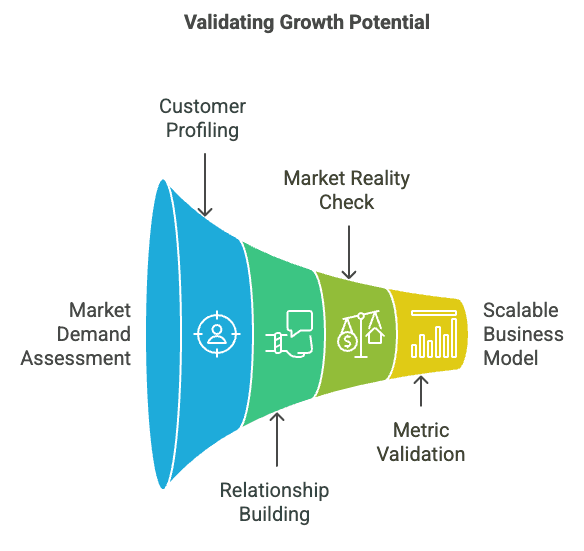
1. Assess Your Realistic Growth Potential
→ Validate Market Demand First
Systematically identify high-potential customers through data-driven customer profiling. Build relationships to pressure-test your value proposition and refine your product-market fit using real feedback.
→ Match Ambitions to Market Realities
If serving local/narrow markets, accept that rapid scaling may be constrained by TAM (Total Addressable Market). Prioritize sustainable growth engines: Operational efficiency, retention strategies (e.g., loyalty programs), and expansion into adjacent markets.
Key Validation Checkpoints:
Does your market intelligence confirm strong product-market fit through customer validation metrics?
Can your business model realistically capture enough market share given possible TAM limitations?
What measurable thresholds indicate readiness to scale, such as the CAC (Customer Acquisition Costs) payback period and the LTV (Lifetime Value)/CAC ratio?
→ Key Scaling Thresholds
Your business model must demonstrate its ability to scale profitably. Validate this by tracking:
CAC Payback Period: Time (months) to recoup customer acquisition costs.
Example: CAC of $100 with $50/month gross profit per customer = 2-month payback.
Threshold: ≤12 months (ideally ≤6 for recurring revenue models). Faster payback means your business model generates cash efficiently to fund growth.
LTV:CAC Ratio: Lifetime value of a customer vs. the cost to acquire them.
Example: LTV of $900 vs. CAC of $300 = 3:1 ratio.
Threshold: Sustain ≥3:1. Below 3:1 suggests a flawed business model (overspending or undervaluing customers); above 5:1 may signal underinvestment in growth.
Why This Matters: These simple metrics confirm whether your business model aligns with market realities. A model with fast CAC payback and healthy LTV:CAC can scale without burning cash or sacrificing margins.
Start today! Take ✍ Notes!
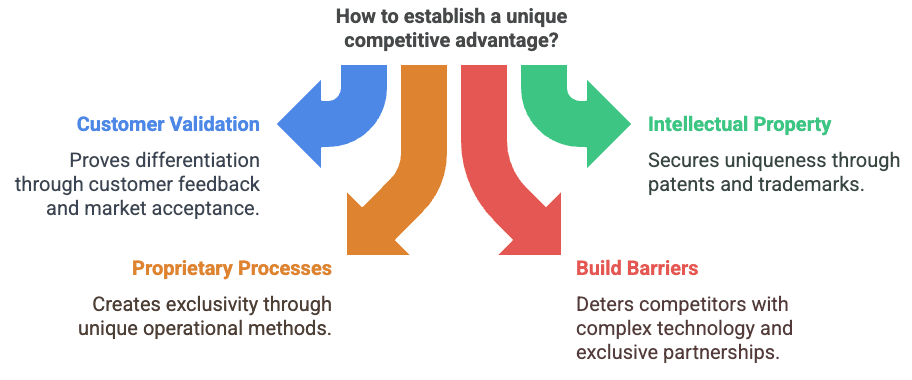
2. Craft a Unique Competitive Advantage
→ Escape the Copycat Trap
If your product/service mirrors competitors’, your growth will plateau. To stand out, uniqueness, originality, or disruption are non-negotiables.
Prove your differentiation through customer validation, intellectual property, or proprietary processes.
Build Copycat Barriers:
Design barriers (e.g., complex technology, exclusive partnerships, brand authority) to deter fast-moving, well-funded competitors.
If your idea is easy to duplicate, your survival and growth will hinge on execution alone—a risky bet.
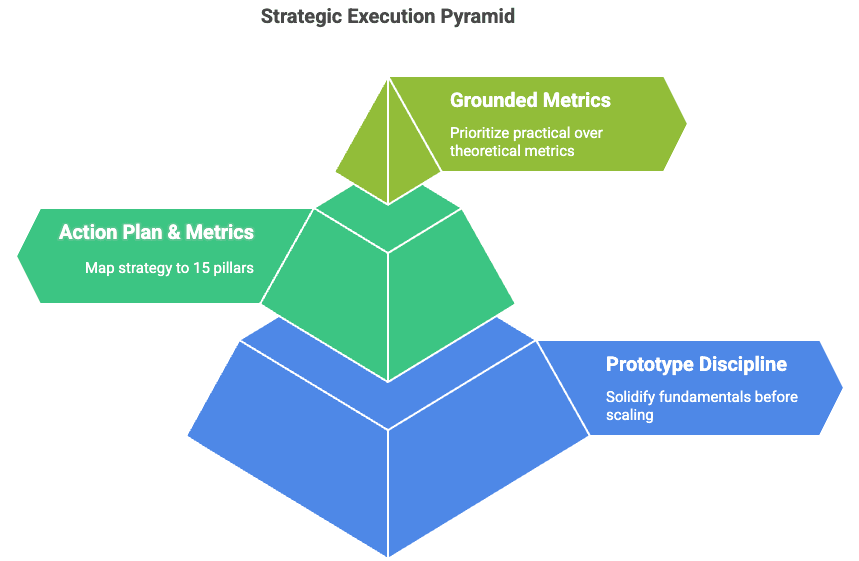
3. Execute Strategically: Master the Basics
→ Prototype Discipline
If you have an early-stage product you’re proud of, solidify fundamentals first: quality control, supply chain reliability, and operational workflows.
Avoid scaling prematurely—a flawed foundation magnifies risks as you grow.
Action Plan & Metrics:
Map your strategy to this course’s “15 pillars” (e.g., market positioning, customer acquisition, and retention).
Prioritize grounded metrics (e.g., CAC, retention rates) over theoretical financial models. Spreadsheet fantasies won’t save your business.
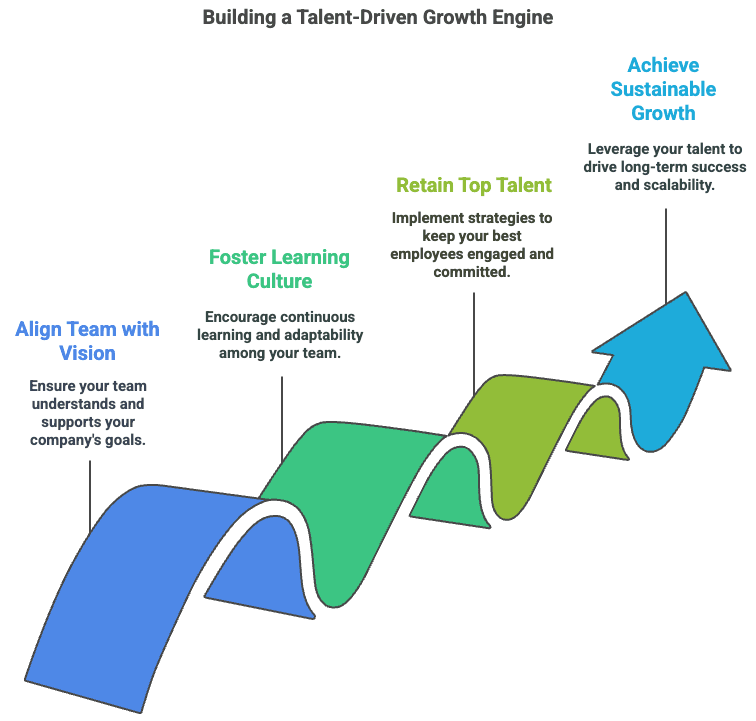
4. Invest in Talent as Your Growth Engine
→ Talent = Sustainable Advantage
Build, expand, and retain a team that aligns with your vision. Talent gaps will stall even the best strategies.
Foster a continuous learning and adaptability culture to stay ahead of market shifts.
Critical Reminder:
Your people are the lever that transforms dreams into a scalable reality.
📣 Beyond Growth Criteria: 12 Key Open Questions on Competitive Differentiation
- Why might we be overestimating potential in certain areas?
- How can we better align expectations with realistic outcomes?
- How long will it take to adjust goals to more achievable levels?
- How much effort or resources are needed to recalibrate expectations?
- When should we communicate these adjustments to stakeholders?
- Who is responsible for identifying and addressing overestimations?
- Why should we focus on creating barriers or sharpening differentiation?
- How can we enhance our unique selling points effectively?
- How long will it take to establish these competitive advantages?
- How much investment is required to build sustainable barriers?
- By when should we see measurable results from these efforts?
- Who will lead the initiatives to sharpen differentiation?
Conclusion: Growth Requires Ruthless Focus
→ Align your business with markets that reward scalability.
Differentiate fiercely, execute meticulously, and let talent drive your momentum.
Growth isn’t luck—it’s engineered.
For the Best Quiz Experience Below:
Our interactive sorting challenges and “Hint” features are optimized for desktop or laptop. If you’re on a smartphone, you may find these exercises easier to navigate on a larger screen.