
Why We Start with the Basics, Your Customers, Not with Your Strategy? 🧠
🕒 Start with your customers with ✍ Note-Taking (30 minutes)
As we embark on this journey together, let’s dive into a crucial aspect of business success: your customers. An updated mastery of Customer Experience (CX), your company-wide customer centricity, consistent sales and marketing adaptability, flawless execution of orders: these count more for reaching excellence and top performance than strategies on paper. Customer Experience is central to all business leaders, as it plays a key role in shaping the relevance of your products and services, maintaining your brand’s excellence, and fostering lasting, high-quality relationships.
Starting with customers doesn’t mean that vision and strategy are secondary; it’s the essence of your business. The fundamental reality is that customers are eager to buy your products and services. Amplifying CX through AI is also essential, provided its efficiency is carefully selected, measured, and driven with caution. Other critical issues need to be addressed, like efficient data management, process re-engineering, continuous training to equip all company members in CX, and mastering the evolution of work and generations. These topics are thoroughly explored and applied throughout your Business Excellence Journey, which gradually guides you toward a final strategic action plan developed step by step during the course.
The Customer-Centric Mindset
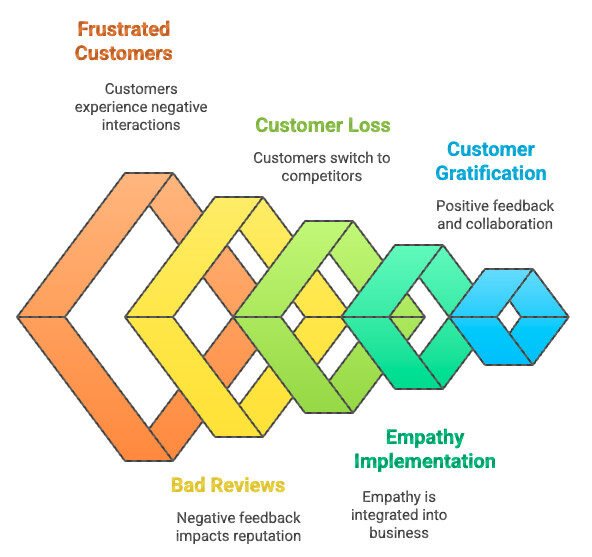
We need to pamper our customers to have high performance. This isn’t just a nice sentiment. It’s a fundamental truth that many companies overlook. Unfortunately, many companies, both large and small, neglect their customers. This creates experiences that frustrate shoppers, generate bad reviews, and drive them to your rivals, killing the business.
When business decisions, processes, and interactions ooze empathy, it indicates true customer-centricity. Leaders should exemplify it, instruct teams, and evaluate actual gratification through comments and collaboration. Is your company genuinely customer-centric across all departments, with actions to match strategy, or just a slogan? Commit fully and transform survival into dominance. We will work on this critical issue in the following practices.
Clear Examples of Poor Customer Experience in Everyday Life
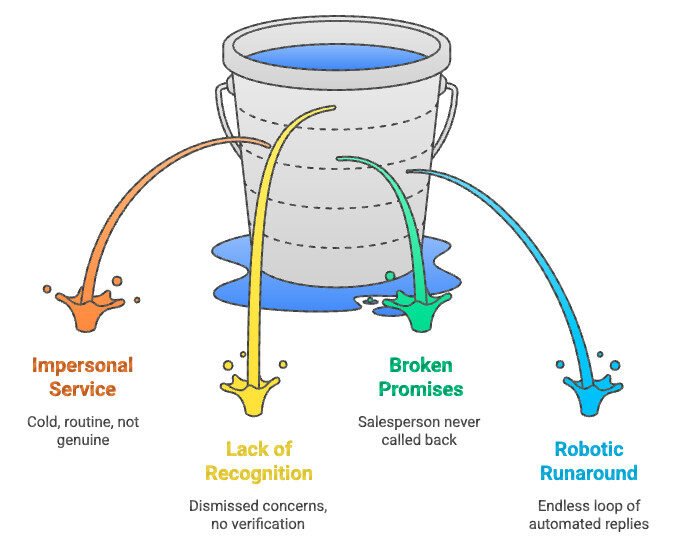
Ordering Coffee Capsules: When I recently called to place an order, the first question from the representative was, “What’s your customer number?” It felt cold and impersonal—more like a routine checkpoint than genuine service.
Banking Frustrations: A friend, a long-standing customer, had to wait in line with no option to speak directly to anyone. The new branch manager dismissed her concerns by saying it was simply “the rule,” without even verifying her loyalty or account size. This lack of recognition and constant management changes pushed her to switch banks altogether.
Battery Purchase Disappointment: I urgently needed batteries for my solar system and called a local store. The salesperson asked me to quote the website price and promised to call back with confirmation—but never did. Frustrated, I ordered them elsewhere.
AI or Robotic responses that make you quit: Last week, I reached out for a simple refund but got stuck in an endless loop of automated replies repeating generic phrases, completely ignoring my real issue. Frustrated by this robotic runaround, I faced a long and tedious resolution process. In the end, I switched to a competitor—showing how easily businesses can lose loyal customers when they rely too much on impersonal automation.
These stories reveal a widespread problem: poor customer experiences affect many industries, from retail to banking and beyond. You probably have your own examples. Exceptional customer interaction isn’t optional—it’s essential.
Doubling your sales is not just a dream. It’s within reach when you align your vision, strategic action plans, processes, product offerings, and teams to exceed customer expectations. Everything —everything starts with your customers. And your customer experience. When was the last time you measured yours? How do you compare with the competition?
Assessing Your Offerings and Boosting New Marketing and Sales Practices
Even if you have cutting-edge products and services, it’s essential to ask yourself:
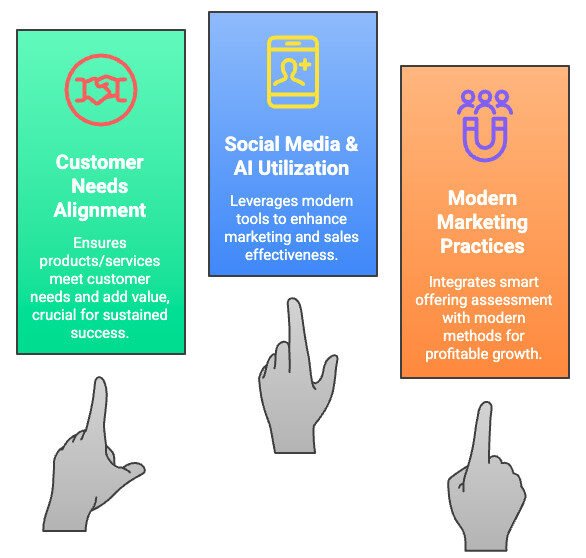
Do they truly meet your customers’ needs?
Are you helping them add value?
Regularly measuring this alignment is crucial for sustained success. Do you have a system in place to do so?
How are you using social media and AI to assess your offerings? Many companies are not leveraging them effectively. Having a Facebook or LinkedIn account is easy. The question is: How does it boost something other than the number of followers? —Above everything: Your sales! Simply acquiring new customers through traditional methods is no longer sufficient. Merging smart offering assessment with modern marketing and sales practices is the roadmap that pays off and impact durably your profitable growth.
Expanding the Call for Change Towards Excellence
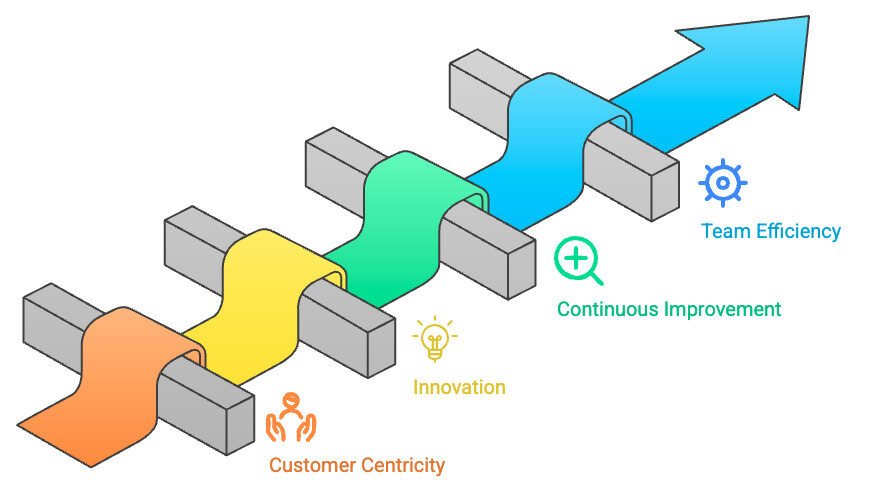
For most businesses—including yours—failing to adapt quickly results in stagnation and missed opportunities. To highlight just four critical areas that demand attention:
- Customer centricity must be at the heart of everything.
- Innovation is the essential engine driving growth.
- Continuous improvement should be relentless and uncompromising.
- Team efficiency is the foundation for sustained success.
Every business leader understands these priorities. The pressing questions you face are clear:
⭐ How well are we performing across these vital areas?
⭐ How do we effectively integrate these elements into our business model to maximize long-term sustainability?
⭐ How successful are we in adopting and applying modern performance methodologies?
Without mastering these essentials, building a winning strategy is impossible.
Now let’s focus on your customer experience, competitive intelligence, and your golden sales boosters to move forward with all 15 Pillars that support your 110 lessons, which are expressively called Practices.